Most commercial property maintenance plans in Edmonton are written in January, in a hurry, by somebody standing in a puddle. That's the version where a rooftop unit quits during a cold snap, the emergency call-out costs three times the scheduled service, and a tenant sends the kind of email that gets forwarded to the owner. The alternative isn't complicated — it's a calendar. This is a season-by-season plan for a single building or a multi-site portfolio, built around the way an Alberta year actually behaves rather than a generic checklist written for a milder climate.
What does commercial property maintenance actually cover?
Broadly, everything recurring that keeps a building open, safe and presentable — as opposed to repairs, which are what happens after the recurring work gets skipped. On a typical Edmonton-area site, property maintenance services break into six lines:
- Interior. Janitorial and commercial cleaning, floor care, restroom stocking, entrance matting, lighting and lamp replacement.
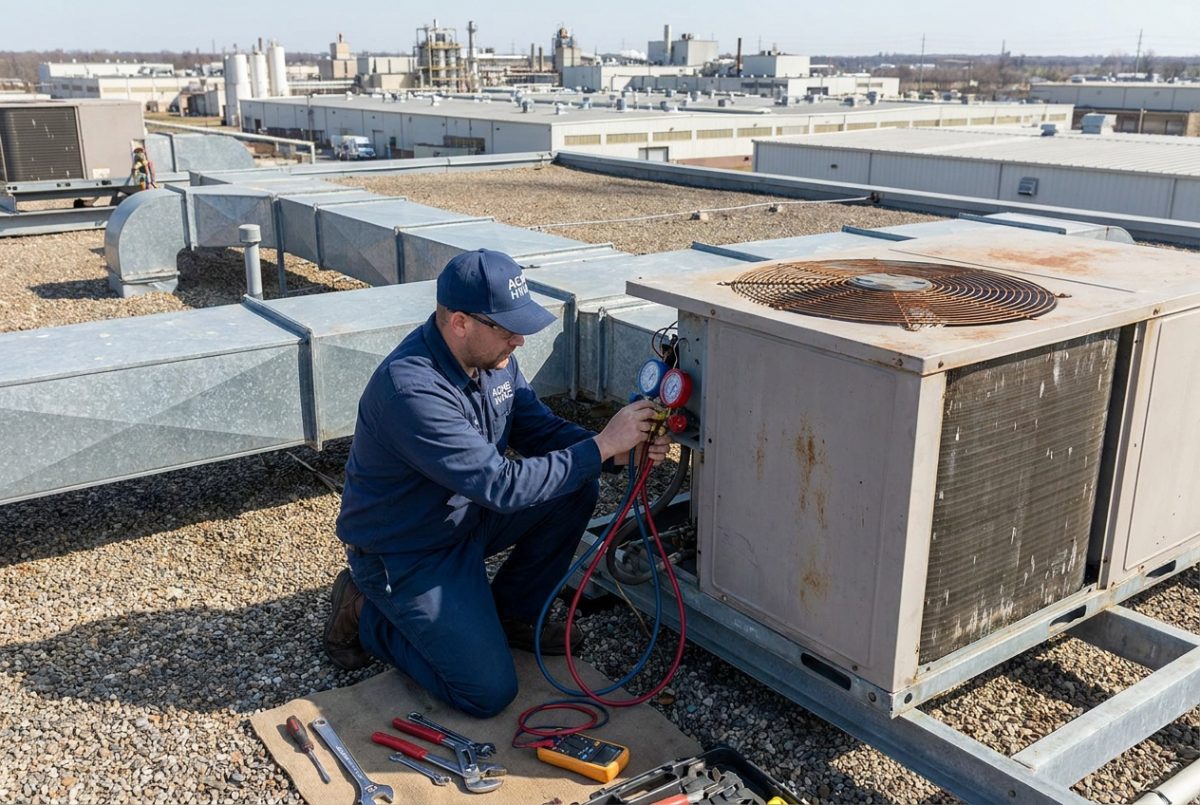
- Mechanical. HVAC filter changes and seasonal changeovers, belt and coil checks, thermostat programming, exhaust fans.
- Plumbing. Fixture checks, drain maintenance, backflow, water heaters, and the outdoor taps nobody thinks about until October.
- Waste. Bin service, recycling and organics streams, enclosure cleanliness, overflow before long weekends.
- Grounds. Landscaping, lot sweeping, line painting, litter, and snow removal with ice control from roughly late October to April.
- Records. Service logs, inspection dates and certificates — dull until something goes wrong, then the most valuable file you own.
Retail property maintenance adds storefront glass and higher-traffic entrance care; industrial sites add dock areas and heavier lot loads. The categories don't change, only the frequency.
Why does an Edmonton maintenance plan have to be seasonal?
Because the building experiences something close to a 70-degree annual swing. Edmonton sits near +30 °C in July and drops below −30 °C in a January cold snap, and Environment Canada's climate normals show how routine that spread is. Between those extremes are the freeze–thaw cycles — the real budget killer. Meltwater runs into a hairline crack in the asphalt at +2 °C, freezes overnight at −8 °C, expands, and widens the crack. Do that thirty times in a spring and you have a pothole, a trip hazard and a line item.
The same cycle pulls door seals out of alignment, ices up roof drains, and puts a hard deadline on every piece of outdoor work: the window for asphalt, paint, sealing and planting is short, and it is shared by every contractor in the region. A flat "monthly checklist" ignores all of that. A quarterly plan puts each task in the season where it's still cheap.
Fall (September–November): the quarter that decides your winter
This is the highest-leverage quarter of the year, and it's the one most often rushed.
- Heating changeover: filters replaced, belts checked, rooftop units serviced before the first hard freeze — not during it.
- Roof and drain clearing, so autumn debris isn't the reason meltwater backs up in March.
- Exterior doors and weather seals — the cheapest heating upgrade available to most buildings.
- Outdoor taps shut off and drained; backflow devices checked.
- Catch basins and gutters cleared; lot swept before snow locks the debris in place.
- Entrance matting staged for salt season. Salt and sand destroy floor finishes faster than foot traffic ever will.
- Snow removal and ice control under contract, with a written trigger depth and response window. Our guide to commercial snow removal contracts covers what that document should say — and why local providers stop taking new sites by mid-October.
Winter (December–February): what changes at −30 °C
Winter maintenance is mostly reactive by design, and the plan's job is to make the reactions fast and documented. Priorities shrink to three: keep people upright, keep the heat on, keep the records.
Ice control matters more than plowing here. Alberta's OHS Act, Regulation and Code requires safe access and egress at a worksite, and the entrance most likely to generate a claim is the one that thawed at noon and refroze at four. Log every de-icing application with date, time and conditions. If a claim arrives eighteen months later, that log is the whole defence.
On the mechanical side, watch make-up air units and anything drawing outside air — they work hardest in the coldest week of the year. Interior humidity swings show up as door and window condensation; catch it before it becomes a mould conversation. And confirm who is clearing the public sidewalk against your property: the City of Edmonton's sidewalk snow and ice rules put that obligation on the property owner, with fines and City contractor costs attached.
Spring (March–May): the freeze–thaw audit
Spring is a damage assessment, not a cleanup. Walk the site once the snow is off and look for what winter moved:
- Asphalt cracks, frost heaves and settled areas around catch basins — sealing in May costs a fraction of patching in September.
- Salt residue on entrances, walkways and floor finishes; a full lot sweep to pull winter sand off the property.
- Landscape beds, irrigation and turf damage from plow piles — worth noting exactly where snow was stored, so next winter's map avoids it.
- Cooling changeover: coils cleaned, condensate lines clear, filters replaced before the first +28 °C week.
- Roof inspection after the melt, while a small membrane repair is still small.
- Exterior wash-down and glass — the first impression a tenant or customer forms in April tends to stick.
Summer (June–August): the only window for planned work
Edmonton's outdoor construction season is short, and every property maintenance company in the region is booked into it. Summer is when you schedule the projects that can't happen in the cold: asphalt repair and sealcoating, line painting, concrete work, exterior painting, landscaping and grounds upgrades, and deferred roof work. It's also the quarter to run the annual audit — review last winter's service logs, re-price the contracts that renew in the fall, and set next year's budget while the evidence is fresh. Book summer work in February or March; by June the good crews are committed.
How much does commercial property maintenance cost in Edmonton?
Site-dependent, and anyone who quotes you over the phone hasn't seen the property. As Edmonton-market ranges rather than our quotes: recurring janitorial commonly runs about $0.08–$0.20 per square foot per visit; seasonal snow contracts land roughly $2,000–$10,000+ for the winter depending on lot size and priority; commercial HVAC preventive maintenance typically runs $150–$400 per rooftop unit per visit. Bundled property maintenance agreements are usually quoted as a single monthly figure after a walk-through.
The number that matters more is the split between planned and emergency spend. Emergency call-outs carry premium rates, after-hours multipliers and whatever the failure damaged on its way out. A plan doesn't eliminate that spend; it moves most of it into a scheduled line you can forecast.
One property maintenance company, or a trade for each job?
Separate trades give you specialist depth and easy price comparison — but you own the scheduling, the seams between scopes, and a folder of insurance certificates with different expiry dates. A single property maintenance company gives you one schedule, one invoice, one contact at 6 a.m., and far fewer conversations about whose job something was. Most single-site and multi-location property maintenance portfolios settle on a hybrid: bundle the recurring seasonal work, keep specialty trades on call. Whichever way you go, put the frequency in writing. "As needed" is not a schedule — it's a disagreement waiting for a cold snap.
Build the calendar before the season does it for you.
E&S Facility Management — the facility division of E&S Contracting Services — handles commercial property maintenance across Edmonton, Fort Saskatchewan, Sherwood Park, St. Albert, Leduc and Stony Plain: cleaning, HVAC, plumbing, waste, grounds and winter service under one facility management agreement. If your fleet needs the same treatment, our Detail Bros division covers that side.
Every agreement starts with a site walk-through, because a maintenance plan written without seeing the property is just a template.
Request a site assessmentOr call 780-619-8731 — fall is the quarter this pays for itself.